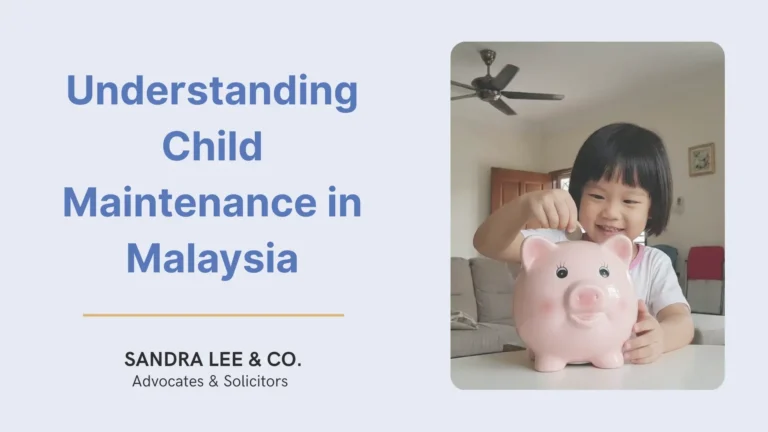
Understanding Child Maintenance in Malaysia: A Complete Guide

Quick Summary
Financial support paid for a child's living expenses, education, and healthcare following parental separation.
Both parents are responsible for maintaining their children, though fathers typically has the bigger responsibility under civil law.
There is no fixed formula - courts determine amounts based on the child's needs and each parent's income.
Maintenance is payable until the child reaches 18 years of age, or longer if pursuing tertiary education or living with disabilities.
Maintenance orders can be varied (to increase or decrease the amount) when circumstances change. A formal application to the court is required for the court to assess a change is required or necessary.
Table of Contents
- What is child maintenance?
- Is only the father required to pay child maintenance?
- How much child maintenance is payable?
— Factors courts consider
— Typical maintenance amount - How long must child maintenance be paid?
— General rule
— Extensions beyond 18 years old - What if the paying parent cannot afford?
— Applying to change maintenance amount
— Common grounds for an increase
— Common grounds for a decrease
— The court’s expectation - What if the paying parent simply refuses to pay?
When parents separate or divorce, one of the most important questions that arises is: who is responsible for supporting the children financially? Child maintenance is a legal obligation that ensures children continue to receive financial support even when their parents are no longer together. If you’re going through a divorce or separation in Malaysia, understanding how child maintenance works is crucial for protecting your children’s welfare.
What is child maintenance?
Child maintenance (also called child support) is money that one parent pays to help cover the costs of raising the children. This payment is required by law, whether you were married or not, and it continues even after your divorce is final.
Why does child maintenance exist? It is to ensure that the children can still have their needs met and live comfortably, even though their parents are separated. The money helps cover:
Is only the father required to pay child maintenance?
Many people think only the father has to pay. That’s not quite right, but there’s some truth to it.
Under the Law Reform (Marriage and Divorce) Act 1976, both parents have a duty to support their children based on what they can afford. However, in practice, fathers usually have the bigger responsibility to pay child maintenance.
The courts recognise that while both parents should help support the children, the father typically has the main duty to provide financially. This means:
How much child maintenance is payable?
There is no fixed formula or standard amount of child maintenance in Malaysia. Unlike some countries where they calculate a set percentage of your salary, Malaysian courts look at each family’s unique situation and decide what’s fair.
Factors courts consider
When deciding how much maintenance should be paid, the court considers:
How old are they? What school do they go to? Do they have any medical condition? What kind of lifestyle did they have before the parents separated?
Their salary, savings, business income, their personal expenses and bills, and whether they can earn more
The lifestyle the child was used to before the separation
How many children are there, whether there are other people depending on the paying parent financially, and any special circumstances
Typical maintenance amounts
While amounts vary widely, child maintenance orders in Malaysia commonly range from RM500 to RM3,000 per child per month, though they can be higher depending on the family’s circumstances and the father’s income. Wealthy families may see maintenance orders of RM5,000 to RM10,000 or more per child.
The court aims to ensure children can maintain a reasonable standard of living while also being fair to the paying parent’s financial situation.
How long must child maintenance be paid?
The duration of the maintenance depends on the child’s circumstances:
General rule
Child maintenance is payable until the child turns 18 years old. This is the age of majority in Malaysia.
Extensions beyond 18 years old
However, child maintenance can continue beyond 18 years old in certain circumstances:
If the child is in college or university or doing other training, the parents may need to keep paying until the child finishes their studies. Typically, parents are expected to keep paying until the child obtains their first bachelor's degree.
If the child has a physical or mental disability that stops them from earning their own living, the parents might have to pay maintenance for as long as the child needs support
The court can order maintenance beyond 18 years old when it’s fair and reasonable, especially for education costs.
What if the paying parent cannot afford?
Life circumstances change. A parent ordered to pay maintenance may experience employment loss, business failure, illness, or other financial difficulties that make it impossible to meet their obligations. Malaysian law recognises this reality and allows them to apply to the court to change or vary the amount, either asking for an increase or a decrease.
Applying to change maintenance amount
Either parent can apply to the court to increase or decrease the maintenance amount when something major has happened.
Common grounds for an increase
Common grounds for seeking an increase include:
Common grounds for a decrease
Common grounds for seeking a decrease include:
The court's expectation
However, it’s crucial to understand that courts take the father’s maintenance obligation very seriously. Simply losing a job or experiencing reduced income may not be enough reason to decrease the maintenance. The court will expect the father to:
Courts understand that a father’s duty to support his children comes first, and he cannot simply claim poverty without proving that he has done everything possible to earn money. He is expected to put his children’s needs first, even if that means accepting a job below his previous position or working more than one job.
What if the paying parent simply refuses to pay?
Failure to pay court-ordered maintenance is a serious offense. While the custodial parent has several ways to enforce the payment (to be discussed in a separate post), a major consequence is that the paying parent can be sent to jail for being in contempt of court.
Final thoughts
Child maintenance can become complicated, especially when there are disagreements about money, what the children need, or when someone isn’t paying. Every family’s situation is different, and the law gives courts flexibility to make orders that work best for the children.
If you are dealing with child maintenance issues, whether you need to apply for it, want to change an existing order, or need to enforce payment, consulting with a family lawyer can help you understand your rights and responsibilities and ensure the best outcome for your children.
If you are looking for an experienced family and divorce lawyer in Kuala Lumpur (KL) & Selangor, reach out to Sandra via WhatsApp for a consultation to discuss and explore your legal options in Malaysia.